

The Gig Economy Lesson

Job Security is gone. The driving force of a career must come from the individual.
Intro
This lesson idea revolves around the theme of the employment trends and the job market. Typically, course books and most school classes focus on the generic jobs we’ve all heard about a million times but rarely do they provide some variety and how the market is changing and new jobs are being created. The focus here is on “gigs” referring to self-employment in which people can choose their own hours and have some independence but this comes at the expense of benefits most full-time employment jobs provide. If you’re looking for a lesson idea that focuses on the employment trends mostly then I have a dedicated lesson idea just for that here. Alternatively if you are looking for a language-based lesson on how to describe trends here is this one I have made, which is one of my most successful and popular lessons.
Warm Up
Introduce the topic by writing GIG on the board and asking students what it means? If nobody knows tell them it has two meanings in different contexts. One is in performances – a gig is typically in a bar or cafe, small club. A concert is in a much bigger venue. The other meaning is for jobs. Can they guess what kind of a job is a gig? If not, explain that a gig is a job where you are self-employed and look for customers (typically on the internet) to earn money. In comparison to an employment contract which you sign and then have to go to work for 8 hours a day and follow certain rules and protocol.
Ask them what types of gig jobs they have heard of online that people do, Brainstorm.
Speaking
- What are the short-term and long-term benefits if any when deciding to be Self-employed and joining the Gig economy? What are these same things when deciding to get full-time employment? (This question can be done as a brainstorm in pairs. Pairs are giving the GIG question or the Full employment question. After brainstorming the pairs are mixed up so they can share their ideas with someone who brainstormed the other question. Get feedback.
Decision making
- Do you want to be involved in the decision-making?
- Do you prefer to be told what to do?
- Do you like having more responsibility? What are the pros and cons of having more responsibility?
Vocabulary
Write the word “benefits” in capital letters on the board and draw a circle around it. Then brainstorm with the class all the benefits they can think of that come with a job. Ask them what do we call the benefits that I job gives us? Answer: PERKS (you can draw a circle around this word instead.
Possible words in your spidergram (Perks): coffee/tea, training development budget, English lessons, Public transport paid, snacks and fruit, Lunch, breakfast, discounts card
Additional words to add if you use “benefits”: bonus, health insurance, pension contributions, paid vacation, sick leave, flexible working hours
Vocabulary and Speaking with Prefix focus
Note: You don’t have to use all the words or the suggested prefixes, pick and choose what your focus will be.
Words Associated with “The Gig Economy”
1. Precarious (semi-precarious, non-precarious)
2. Sustainability (unsustainability, self-sustainability)
3. Diversify (re-diversify, over-diversify)
4. Autonomous (semi-autonomous, non-autonomous)
5. Frequent (infrequent, non-frequent)
6. Monetize (pre-monetize, over-monetize)
7. Stable (unstable – as in unstable schedule, unstable conditions)
8. Volatility (high-volatility, low-volatility)
9. Optimize (sub-optimize, re-optimize)
10. Adaptable (non-adaptable, over-adaptable)
6 Questions Incorporating the Words
1. How does the gig economy affect the sustainability of a worker’s income compared to traditional employment?
2. Why might a precarious work environment discourage people from joining the gig economy?
3. In what ways can workers diversify their skills to remain competitive in the gig economy?
4.How important is it for a gig worker to remain adaptable to changing market demands?
5. What steps can companies take to optimize their relationship with gig workers for mutual benefit?
6. Do you think the volatility of gig-based earnings outweighs the freedom it offers?
Here are 5 additional questions incorporating the vocabulary:
1. How can a worker monetize their skills effectively in a highly competitive gig economy?
2. Do you think inconsistent work schedules in the gig economy make it harder to maintain a healthy work-life balance?
3. Why is autonomous decision-making crucial for success in the gig economy?
4. How could volatility in demand for gig workers impact their mental well-being?
5. In what ways could gig workers improve their frequent interactions with clients to build long-term relationships?
These questions encourage critical thinking and application of the vocabulary in meaningful contexts.
Reading
What’s the sharing economy? Provide examples.
This reading is taken from the Evolve Advanced series: 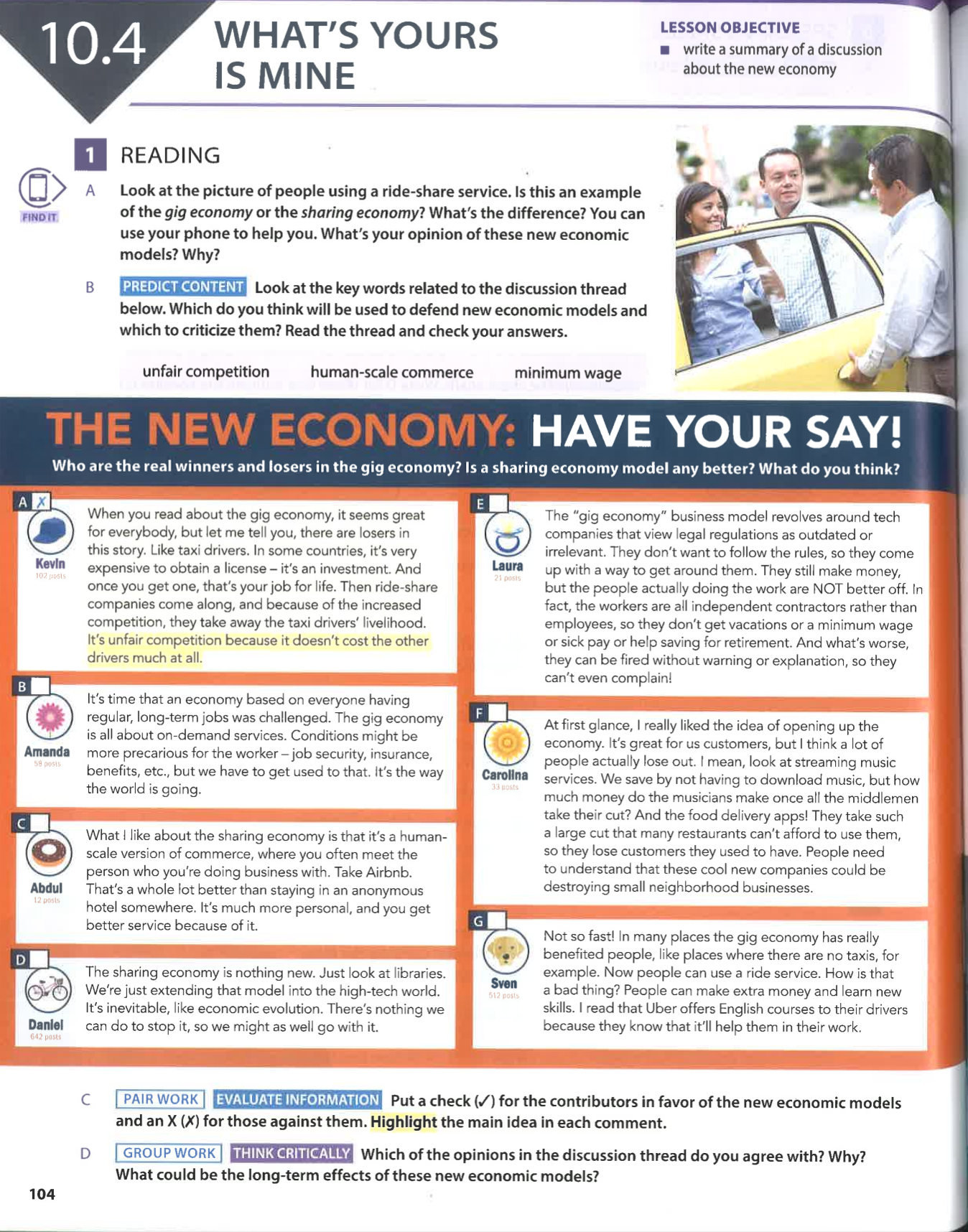
This reading is for advanced students but you can do the A,B,C,D sections on this page easily and it is perfect for the topic.
Alternatively you can
Reading comprehension questions
Language focus
Comparative structures
Comparative structures are practical to know and utilise in speech. This language focus is particularly useful for this topic so you can encourage students to compare the two or three different job options.
Explanation of Comparative Structures
Comparative structures are used to compare two things. For B2-level students, it’s important to focus on phrases that express both small and large differences.
Key Structures for Comparisons
1. Basic Comparatives:
•X is more flexible than Y.
•Freelance work is less predictable than traditional jobs.
•The gig economy is as challenging as a full-time job in some ways.
2. Expressing Small Differences:
•Slightly: Freelance work is slightly more stressful than regular employment.
•A bit: Gig jobs are a bit harder to find than permanent positions.
•Nearly as: This job is nearly as flexible as freelancing.
3. Expressing Large Differences:
•Much: The gig economy is much more unpredictable than traditional careers.
•Far: Gig workers have far fewer benefits than full-time employees.
•Nowhere near: Freelancing is nowhere near as stable as a corporate job.
Exercise 1: Fill in the Gaps (Small and Large Differences)
Instructions: Complete the sentences with the correct comparative structures.
1.Freelance work is _______ more flexible than office jobs, but it’s also _______ less secure. (small/large)
2.The income of a gig worker is _______ as reliable as that of a salaried employee. (small)
3.Being self-employed is _______ harder than working for a company because of inconsistent income. (large)
4.Gig workers usually have _______ fewer benefits than permanent employees. (large)
5.Part-time contracts are _______ nearly as stable as full-time positions. (small)
Exercise 2: Rewrite the Sentences Using Comparative Structures
Instructions: Rewrite each sentence to include a phrase expressing either a small or a large difference.
1.Gig work is flexible, but it is also insecure. (Use “far” to emphasize the insecurity.)
•Example answer: Gig work is far less secure than traditional employment.
2.Freelancers often earn less than salaried employees. (Use “slightly” to soften the comparison.)
3.Finding work on gig platforms can be harder than networking for a traditional job. (Use “nowhere near” to emphasize the difficulty.)
4.Traditional jobs have more structure than gig work. (Use “much” to emphasize the difference.)
5.Freelance work offers fewer opportunities for career development than office jobs. (Use “a bit” to minimize the gap.)
These exercises will help students practice forming comparisons while also deepening their understanding of the gig economy topic. Choose any of these and mix it up as you please.
Want lessons like this delivered live?
I work one-on-one with business professionals who need focused, results-driven English coaching — not just another worksheet.
See how I work with clients →